Most consumer brands have an origin story that has been sanded smooth: a founder, a garage, a good idea. Oneida has one that nobody in marketing would have invented, because it is genuinely strange, occasionally uncomfortable, and entirely documented.
The company that put flatware in millions of American kitchen drawers started as a religious community that abolished private property, organised work collectively, and rejected conventional marriage. It funded itself by selling animal traps. It made spoons almost by accident. And it outlived its own utopia by more than a hundred and forty years.
A farm on Oneida Creek, 1848
In 1848 a preacher named John Humphrey Noyes moved a group of followers from Putney, Vermont to a stretch of land beside Oneida Creek in upstate New York. Noyes taught a doctrine called Perfectionism, which held that a Christian could be free of sin in this life rather than the next. From that starting point he drew conclusions that scandalised his neighbours in Vermont and got him run out of the state.
The community that formed on Oneida Creek held property in common. It rotated jobs so that no one person was stuck permanently with the worst work. It raised children communally after weaning. And it practised a system Noyes called complex marriage, in which the community as a whole was considered married and exclusive pair bonds were discouraged.
It is worth being clear that these arrangements were controversial then and remain so now, and that later scholarship has been unsparing about the power a charismatic leader held over the people inside such a system. What matters here is where the flatware came from, not a defence of how the community organised itself. But the arrangement matters commercially for one specific reason: with no household economies to run and no private property to accumulate, the community could put an unusual share of its collective labour straight into manufacturing.
Traps, silk, and the accidental factory
The community needed income, and it found it in metal. Its first real commercial success was the animal trap, produced in volume and sold across the expanding frontier. A silk thread mill followed. Both required exactly the same underlying capability: forming, joining and finishing metal and fibre at scale, with a disciplined workforce that did not have to be paid conventional wages.
Skill accumulated. The chain and trap works taught the community how to work steel. And somewhere in the 1870s, a group that already knew how to press, form and finish metal in quantity started producing knives, forks and spoons.
That progression is the whole story in miniature. Oneida did not set out to make tableware. It arrived at tableware because tableware was what its accumulated skills happened to be good for.
A community organised around sharing everything turned out to be extremely good at making the objects people share a table with.The irony is not lost on anyone who has read the history
1880: the utopia incorporates
By the late 1870s the community was under sustained external pressure and internal strain. Noyes left for Canada. In 1880 the community dissolved its communal arrangements and reorganised itself as a joint-stock company, distributing shares among its members.
It is a remarkable pivot to read about. The same people, in the same buildings, with the same machines, woke up one morning as shareholders in a corporation rather than members of a commune. The Mansion House, the 93,000 square foot building the community had put up in phases between 1848 and 1880, went from being a shared home for around three hundred people to being an artefact of something that had ended.
It still stands, in Oneida, New York, as a museum and a National Historic Landmark. It is the address in our footer, and it is worth visiting if you are ever nearby.
Community Plate and the birth of a household name
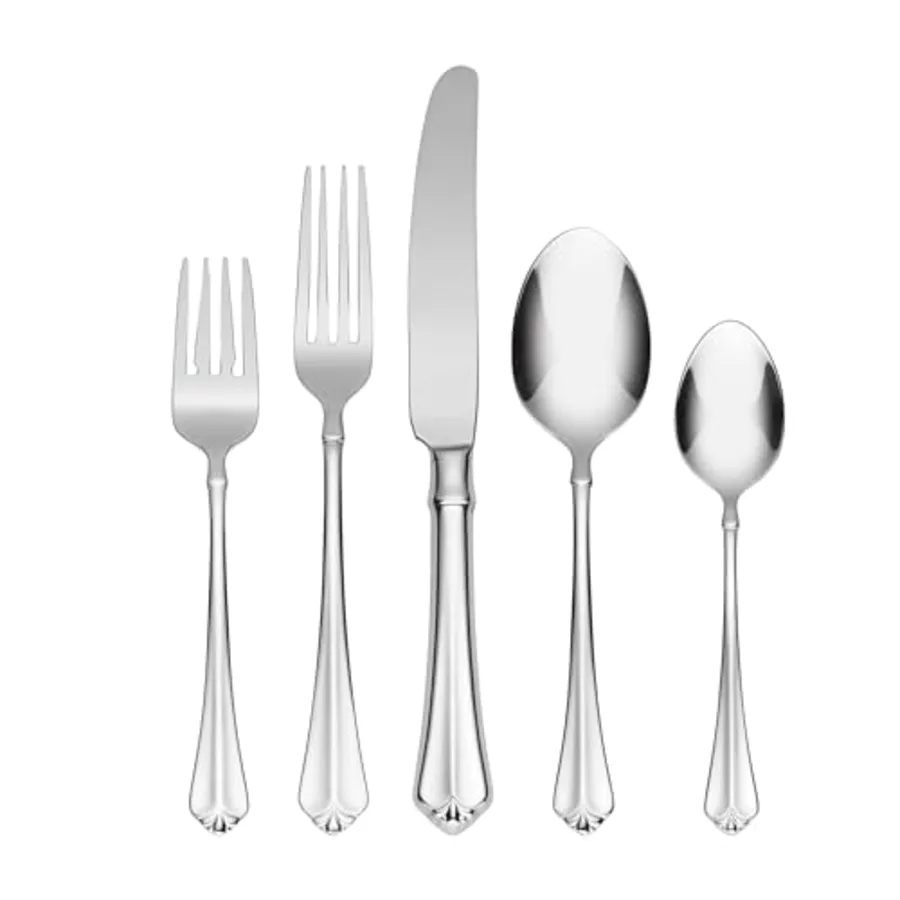
In 1899 the company began producing silver-plated flatware under the mark Community Plate. The name was a direct nod to where the company had come from, and it is the point at which Oneida stops being a regional metalworks and starts becoming a household name.
Silverplate was the right product at the right moment. It gave a rising American middle class the visual depth of real silver at a price that did not require inherited money. A young couple could set a table that looked like their grandparents' without the cost. For decades, Community Plate was what an American wedding present looked like. If a canteen of it has come down to you, the practical questions of how to polish it and what will strip the plating for good are answered in the care article's section on tarnish.
The company also became an early and aggressive advertiser, commissioning illustration work that put its flatware into aspirational domestic scenes. If you have seen early twentieth-century American magazine advertising, you have probably seen it.
Sherrill: a company that built a town
The figure who ran the company through this period was Pierrepont Burt Noyes, son of the founder, raised inside the community itself. What he did next is unusual enough that it deserves its own paragraph.
From 1905, the company laid out plans for a town at Sherrill, New York, for the people who worked in its plant. It offered bonuses to employees who built their own houses there. This was not a company town in the extractive sense of the phrase, where the employer owns the housing and the store and the debt: the intent was employee ownership of actual homes.
Sherrill became the manufacturing heart of the business, and remained so for most of the twentieth century. The plant there did the die work, the pressing and the polishing that turned coils of steel into flatware. If you own an older piece of American Oneida, it was very likely made in that building.
The turn to stainless
In 1961 the company moved into stainless steel flatware. It is easy to read that as a simple material substitution. It was not. It changed the economics and the habits of the entire category.
Silverplate demands maintenance. It tarnishes, it needs polishing, and the plating is a finite layer that wears at the high points of a pattern. Stainless does not tarnish, tolerates the dishwasher that was arriving in American kitchens at exactly that moment, and can be sold at a price that makes a full service an ordinary purchase rather than a milestone one.
The alloys that mattered were the ones we still argue about: 18/10 and 18/8 in the Type 304 family, and 18/0 in Type 430. If you want the metallurgy, our alloy guide sets the three side by side and explains what those numbers do to a fork over a decade.
Half of all American flatware
By the 1980s, Oneida was making at least half of all the flatware purchased in the United States. That is a market position almost no consumer manufacturer in any category ever reaches. For a generation of Americans, "Oneida" and "flatware" were close to interchangeable words, in the way that some people still say a vacuum cleaner is a Hoover.
The company also expanded well beyond the household drawer. It acquired Buffalo China in 1983, ran the Sant'Andrea premium line and the Schönwald foodservice brand, and supplied hotels, restaurants and airlines. If you ate off institutional tableware in North America in the late twentieth century, there is a reasonable chance of whose it was.
Bankruptcy, and what came after
The rest of the story is the one that happened to most American consumer manufacturing.
Global competition, retail consolidation and the cost of domestic production caught up. The company filed for Chapter 11 in 2006 and was taken private. Its parent company, EveryWare Global, went through its own bankruptcy in 2015. In 2021, Oneida Consumer LLC was acquired by Lenox Corporation, the American china maker, which is where the brand sits today.
And here is the part that we think is worth stating plainly rather than glossing: Oneida no longer manufactures in the United States. The company designs, specifies and markets, and the actual making is done under contract at plants around the world. Anybody telling you a new Oneida fork was forged in upstate New York is selling you a story that ended some time ago.
What happened to the Sherrill plant is the best coda the story could have had. Two former Oneida managers bought the factory and its tooling and started making flatware there under their own name, Liberty Tabletop. They are, as of today, the only company still manufacturing flatware in the United States, and they do it in the building Oneida built. We put them in our comparison table for exactly that reason: if American manufacturing is your deciding factor, they are the honest answer.
What survives
So what is Oneida now, and why does the name still carry weight?
Three things survive, and all of them are real.
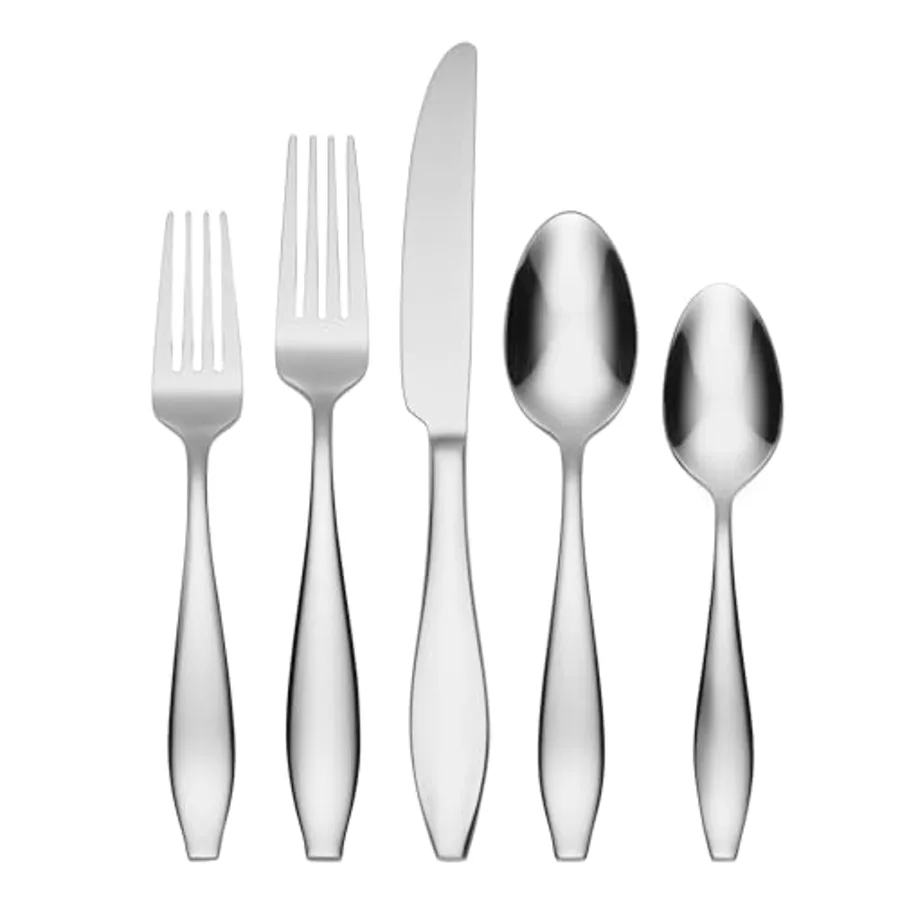
The first is the back catalogue. A hundred and forty years of pattern design is not something a new brand can conjure. Names like Michelangelo, Juilliard, Flight and Chateau have been in production long enough that people inherit them, and that history is why the open stock matters.
The second is open stock itself. A great many flatware brands sell you a boxed set and nothing else. If you lose a fork, you buy another box. Oneida has historically supported buying single pieces and dozens, which is what lets an inherited service stay in use across generations instead of becoming an incomplete drawer. Our open stock section exists for precisely that, and there is a longer argument for when to buy open stock rather than another box.
The third is the standard the name set. When one manufacturer supplies half a national market for a generation, it defines what people expect a fork to feel like. That expectation is still the baseline the category is judged against.
The commune is long gone, and the American factories with it. But the objects it learned to make are still on the table, which is a stranger and more durable legacy than anything Noyes was aiming at.
If you want to see where it all started, the heritage page has the timeline and the address of the Mansion House. If you would rather just set a table, the complete services are where most people begin. From there, the guides on choosing a set and the one rule that generates every table setting cover the rest.