Almost every complaint about flatware comes down to one of three chemical reactions, and people routinely apply the fix for one to another. Polishing tarnish off stainless does nothing, because stainless does not tarnish. Scrubbing pitting does nothing, because pitting is a hole. Knowing which of the three you are looking at takes about ten seconds and saves a lot of pointless effort.
If you want the underlying metallurgy first, the alloy guide explains what chromium and nickel are doing. Everything here is purely practical.
Three different problems that look alike
| What you see | What it is | Reversible |
|---|---|---|
| Cloudy grey or rainbow film across the surface | Filming from detergent or hard water | Yes, easily |
| White spots or streaks that wipe off | Mineral deposits from drying water | Yes, easily |
| Small dark freckles that will not wipe off | Pitting corrosion in the steel | No |
| Even yellow, brown or black darkening on silver | Tarnish, a sulphur reaction | Yes, with polish |
| Copper or pink patches on a silver piece | Plating worn through to the base metal | Only by replating |
The test for the difference between filming and pitting is a fingernail and good light. Film sits on top and comes off. Pitting is below the surface and catches your nail.
The dishwasher question, settled
Yes, stainless flatware goes in the dishwasher. That was the entire point of the industry's move to stainless in the 1960s. But four conditions decide whether it comes out looking new or looking five years older than it is.
Rinse off salt and acid before loading. This is the single highest-value habit in this article. Vinaigrette, tomato, mustard, lemon, egg and anything brined are all chloride or acid sources, and the damage happens in the hours a loaded dishwasher sits before it runs, not during the wash. A ten-second rinse removes the problem entirely.
Do not mix metals in the basket. Stainless resting against aluminium in standing water sets up a small galvanic cell. Silver and stainless together is worse: the reaction accelerates tarnish on the silver dramatically. Keep silverplate out of the dishwasher entirely and keep aluminium in its own corner.
Unload promptly. Flatware left sitting in a humid machine after the cycle is flatware sitting in warm condensate. Most spotting complaints trace to this alone.
Load handles down, mostly. Handles down cleans better; handles up dries better and is safer for knives. Split the basket: forks and spoons handles down, knives handles up, and never pack a compartment so tightly that pieces nest and shield each other from water.
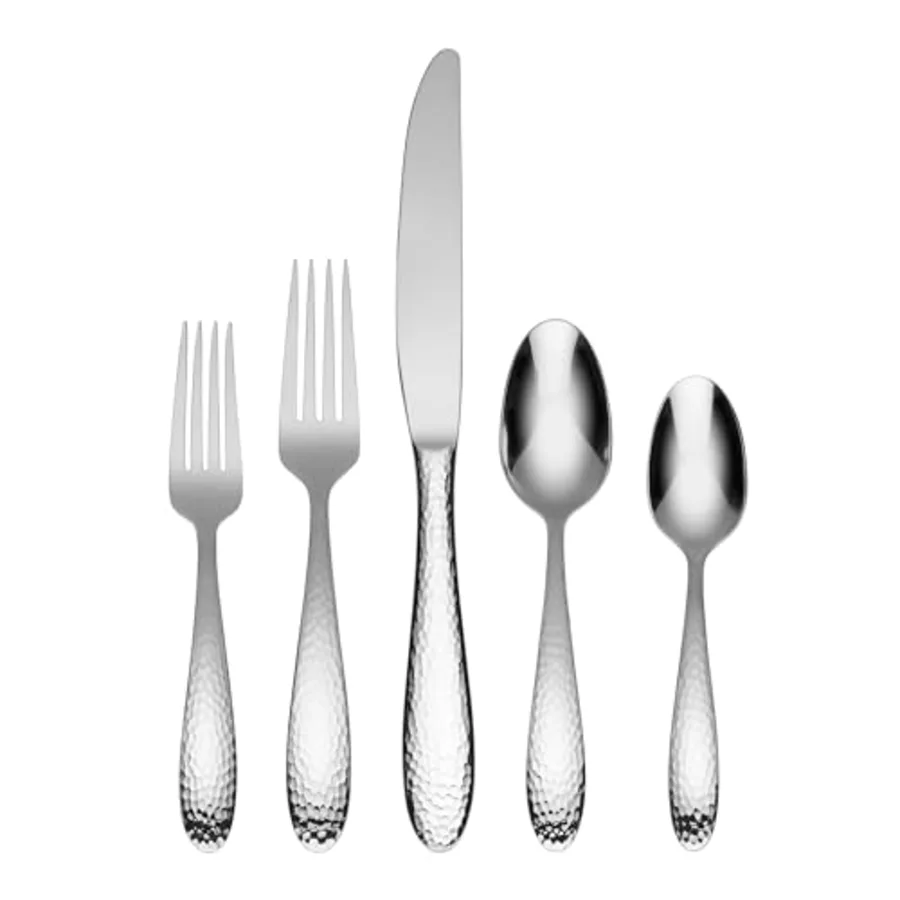
Spotting, filming and hard water
If the whole drawer has gone dull at the same rate, the cause is almost never the flatware. Three suspects, in order of likelihood.
- Hard water. Dissolved minerals stay behind when droplets evaporate. Fix: rinse aid, hotter final rinse, or towel dry.
- Too much detergent. More is not better; excess leaves a film that dulls everything uniformly. Try halving the dose for two weeks.
- Chlorine-bearing detergent. Chlorine attacks the passive chromium oxide layer. If your detergent lists hypochlorite, switch it before blaming the steel.
To remove existing film: a paste of bicarbonate of soda and a little water on a soft cloth, worked along the length of the piece rather than across it, then rinsed and dried. For mineral scale, a brief soak in one part white vinegar to three parts warm water, then a thorough rinse. Do not leave stainless soaking in vinegar for hours; a few minutes is the whole treatment.
Pitting: the one that is permanent
Pitting is small, dark, and does not come off. It is localised corrosion where chlorides have broken through the passive layer and eaten into the metal beneath. Once a pit exists, it is a hole, and no polish fills it.
Pitting is why the rinse-before-loading habit matters more than any product you can buy. It is also more common on 18/0 than on 18/10, because the nickel in Type 304 alloys is specifically what improves chloride resistance. The alloy guide sets out why nickel is the expensive half of the number, and how to tell which one you own with a fridge magnet.
If you already have pitted pieces, they are still perfectly safe to eat with. They will simply always look like that. This is the argument for buying open stock rather than replacing the whole service: our open stock section exists so a few casualties do not force a new set, and there is a fuller case for treating open stock as the default rather than the fallback. It is also part of why selling single pieces at all is one of the three things that survived the company's collapse.
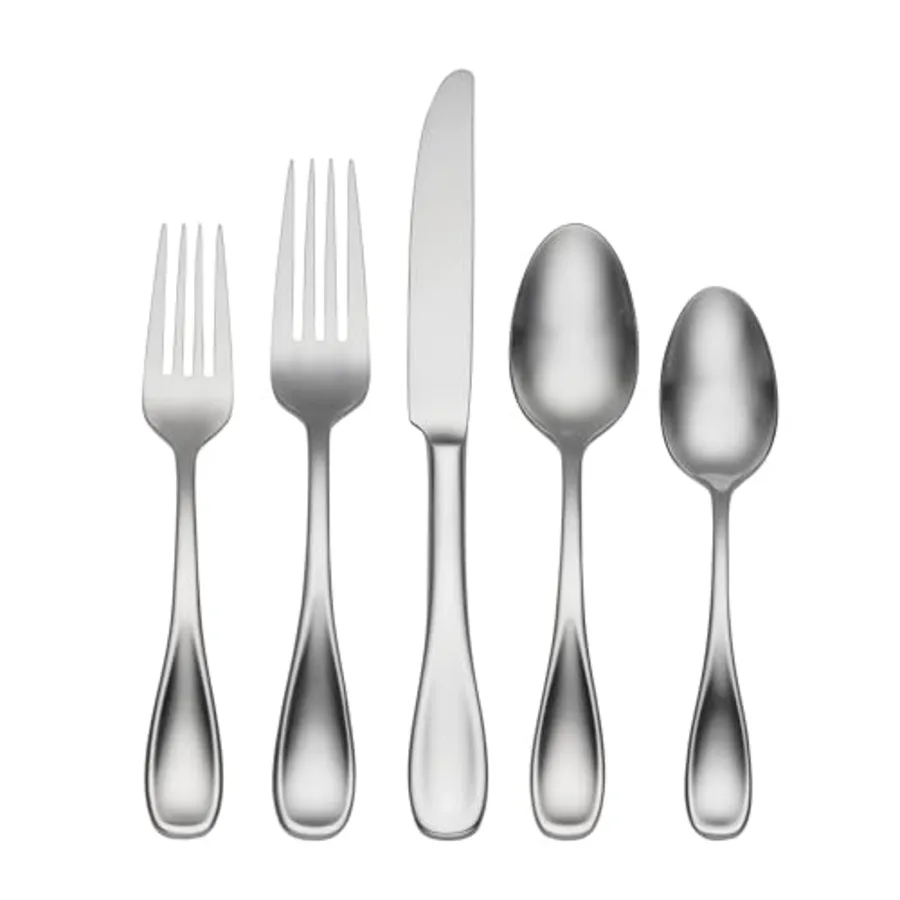
Tarnish on silverplate
Silver tarnish is a completely different reaction. Silver reacts with sulphur compounds in air and food to form silver sulphide, which is the yellow-to-black darkening you see. It is a surface film, it is not corrosion, and it comes off.
Foods that accelerate it: eggs, mustard, mayonnaise, onions, brussels sprouts, anything with a noticeable sulphur note. Rubber bands and some rubber mats are surprisingly aggressive tarnish sources and should never be used to bundle silver.
To remove tarnish: a proper silver polish, applied with a soft cloth, worked in straight strokes along the piece, then washed in warm soapy water and dried completely. Straight strokes matter because circular rubbing produces a visible swirl pattern under raking light.
What never to do to plate
The internet is full of a trick involving aluminium foil, hot water and bicarbonate of soda, which converts the tarnish back to silver electrochemically. It genuinely works. Do not use it on silverplate.
Here is why. The reaction strips tarnish from the entire surface at once, including from inside the fine detail of a pattern where a little darkening is what gives the design its depth. On sterling that is a matter of taste. On plate it also tends to leave a slightly flat, matte surface, and repeated treatments are hard on a finite plating layer. Plate has only so much silver on it, and every aggressive treatment spends some.
Also avoid: abrasive cream cleansers, steel wool, scouring pads, and the dishwasher. Any of these will take plate off faster than years of ordinary use.
The plating on a piece of silverplate is a budget. Every harsh clean spends some of it, and it cannot be topped up at home.The reason gentle beats thorough
A maintenance routine that takes no time
| Every use | Every month | Twice a year |
|---|---|---|
| Rinse acid and salt off before loading; unload promptly | Towel dry the pieces that live in the front of the drawer | Polish any silverplate; check the drawer liner for damp |
That is genuinely the whole programme for stainless. Households that do the first column and nothing else have flatware that looks new after ten years.
Storage
Three rules, all about keeping air moving and sulphur away.
- Dry completely before it goes away. Trapped moisture in a closed drawer is where slow damage happens.
- Do not bundle with rubber bands. Rubber releases sulphur and will print a dark stripe onto silver within weeks.
- For silver in long-term storage, use anti-tarnish cloth or a lined chest, and keep it out of contact with stainless. Tarnish-inhibiting strips in the chest are cheap and effective.
For everyday stainless, an ordinary drawer insert is fine. The only real enemy is pieces packed so tightly they stay damp.
Storage is the last step of an evening that starts at the other end of this site: laying the table, then eating off it, then this. If the drawer you are putting things back into is a mix of inherited plate and modern stainless, it is worth knowing that the two age at completely different rates, and that they should not be stored touching.
If you are choosing a set and want it to survive this kind of ordinary life, the metal and finish guide covers which alloy tolerates neglect best, and the complete services list the alloy on every card.